---
title: "FPDS Sunset: What's Changing in GovSpend"
description: FPDS Sunset
---
[Skip to content](https://support.govspend.com/fpds-sunset#main-content)
English
Show submenu for translations
[![GS Logo-GS platform.png\]](https://support.govspend.com/hs-fs/hubfs/GS%20Logo-GS%20platform.png?height=25&name=GS%20Logo-GS%20platform.png)](https://support.govspend.com/?hsLang=en)
- [Home](https://support.govspend.com/)
- [Email Support](mailto:support@govspend.com)
- [Product Health Status](https://support.govspend.com/product-health-status)
- [What's New](https://support.govspend.com/)
Show submenu for What's New
- [New User Onboarding](https://support.govspend.com/govspend-onboarding-journey)
- [Releases & Updates](https://support.govspend.com/releases-updates)
- [Newsletters](https://support.govspend.com/newsletter-archive)
- [Sales Training Videos](https://app.govspend.com/trainingVideos)
Open main navigation
Close main navigation
- [Home](https://support.govspend.com/)
- [Email Support](mailto:support@govspend.com)
- [Product Health Status](https://support.govspend.com/product-health-status)
- [What's New](https://support.govspend.com/)
Show submenu for What's New
- [New User Onboarding](https://support.govspend.com/govspend-onboarding-journey)
- [Releases & Updates](https://support.govspend.com/releases-updates)
- [Newsletters](https://support.govspend.com/newsletter-archive)
- [Sales Training Videos](https://app.govspend.com/trainingVideos)
- English
Show submenu for translations
- [Log into GovSpend](https://app.govspend.com/)
[Log into GovSpend](https://app.govspend.com/)
Skip the browsing—search for the fastest, most relevant results.
- There are no suggestions because the search field is empty.
1. [GovSpend Help Center](https://support.govspend.com/?hsLang=en)
2. [GovSpend Federal](https://support.govspend.com/govspend-federal?hsLang=en)
3. [Introduction](https://support.govspend.com/govspend-federal?hsLang=en#introduction)
# FPDS Sunset: What's Changing in GovSpend
## The U.S. government has shut down the FPDS.gov website, and the underlying FPDS (Federal Procurement Data System) API feed will go offline on July 31, 2026. FPDS is the data source GovSpend has historically used to provide federal contract award data in the Spending & POs module.
To ensure you continue receiving current federal contract award data without interruption, GovSpend is consolidating this data into the **Spending Analytics** module within GovSpend Federal, which uses the SAM.gov data feed — the government's designated replacement for FPDS.
This is a product upgrade. Spending Analytics offers more powerful analysis than the FPDS data previously available in Spending & POs, including pivot views by agency, company, NAICS code, PSC code, set-aside type, and socioeconomic indicators, plus the ability to filter by place of performance.
| [Key Dates](https://support.govspend.com/fpds-sunset#a-key-dates) | [What's Not Changing](https://support.govspend.com/fpds-sunset#c-not-changing) | [What About My Saved Searches?](https://support.govspend.com/fpds-sunset#e-saved-searches) |
| --- | --- | --- |
| [What's Changing](https://support.govspend.com/fpds-sunset#b-changes) | [Where to Find Spending Analytics](https://support.govspend.com/fpds-sunset#d-where-to-find-spending-analytics) | [Frequently Asked Questions](https://support.govspend.com/fpds-sunset#f-faqs) |
#### **Key Dates**
| Date | What Happens |
| --- | --- |
| Already occurred | The FPDS.gov website has been decommissioned by the U.S. government; visitors are redirected to SAM.gov. |
| July 31, 2026 | The FPDS API feed goes offline. FPDS data in Spending & POs will no longer receive updates after this date. |
| August 1 – August 31, 2026 | FPDS data remains visible in Spending & POs (read-only) so you can compare results and complete your transition to Spending Analytics. |
| August 31, 2026 | Historical FPDS data is retired from Spending & POs. All federal contract award data going forward is available exclusively in Spending Analytics. |
---
#### **What's Changing**
- FPDS federal contract award data will stop receiving updates in Spending & POs after July 31, 2026. Historical records remain viewable through August 31, 2026.
- Starting September 1, 2026, Spending & POs will no longer be the place to search federal contract awards. Use Spending Analytics in GovSpend Federal instead.
---
#### **What's Not Changing**
- Federal and SLED (State, Local, and Education) **purchase order** data remains fully available in Spending & POs. This transition only affects federal contract award data sourced from FPDS.
- All other functionality in Spending & POs is unaffected.
> **A note on Unit Price:** Unit Price is a purchase order concept reflecting the per-unit price on a PO. FPDS federal contract award data has never included Unit Price, since federal contracts don't track quantities of goods sold the way purchase orders do. Unit Price data for purchase order records continues to be available in Spending & POs and is not affected by this change.
---
#### **Where to Find Spending Analytics**
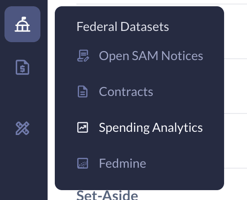
Spending Analytics is available under **Federal Datasets (GovSpend Federal)** in the main navigation menu. It includes all the federal contract award data previously found in Spending & POs, plus:
| Capability | Description |
| --- | --- |
| Analytics pivot by NAICS & PSC | Visual graphs and breakdowns by NAICS and PSC classification codes, not just raw data rows |
| Place of Performance search | Filter results by where work is actually performed |
| Agency & Company analytics view | Instant visual breakdown of results by agency or company |
| Set-asides & socioeconomic indicators | Filter and analyze by small business set-asides, HUBZone, SDVOSB, WOSB, 8(a), and more |
| Richer keyword + filter search | Keyword search combined with deeper, layered filter criteria across the full federal dataset |
| SAM.gov data feed | Ensures current, continuously updated data after the FPDS shutdown |
---
#### **What About My Saved Searches?**
We're currently evaluating the best way to help you bring your saved searches over to Spending Analytics, and we'll share more details as soon as that's finalized. In the meantime, your existing saved searches in Spending & POs remain accessible through August 31, 2026, and you're welcome to manually recreate any searches in Spending Analytics at any time.
---
#### **Frequently Asked Questions**
**Why is FPDS data being removed from Spending & POs?**
The U.S. government has shut down FPDS.gov, and the underlying FPDS API feed will go offline on July 31, 2026. As a result, GovSpend will no longer be able to receive new federal contract award data through FPDS after that date. We're consolidating federal contract data into [Spending Analytics](https://support.govspend.com/federal-spending-analytics?hsLang=en), which uses the SAM.gov feed — the government's designated replacement for FPDS.
**Will I lose any data?**
No. Federal contract award data currently in Spending & POs remains accessible through August 31, 2026. After July 31, it will no longer receive new updates, but historical records will still be viewable. The same data is available — and kept current — in Spending Analytics.
**Where do I find the replacement for FPDS data in GovSpend?**
In the Spending Analytics module, found under Federal Datasets (GovSpend Federal) in the main navigation menu.
**Is Spending Analytics included in my current subscription?**
Please contact your GovSpend Relationship Manager to confirm whether Spending Analytics is included in your current subscription.
**What's the difference between Spending & POs and Spending Analytics?**
Spending & POs combines state/local purchase order data with federal contract award data sourced from FPDS. After July 31, federal contract award data will be available exclusively in Spending Analytics under GovSpend Federal, which also adds analytics pivot views, place of performance filtering, and other capabilities not available in Spending & POs.
**What happened to Unit Price?**
Unit Price applies only to purchase order records and was never part of FPDS federal contract award data. Unit Price data for purchase orders continues to be available in Spending & POs.
**Do I need to do anything before July 31?**
We recommend [exploring Spending Analytics](https://app.govspend.com/federalTransaction?userflow=ab3aaf22-63a0-4784-84b3-95d929cfbe6b) now to get familiar with the interface, and contacting your Relationship Manager to confirm your access.
**What happens to my purchase order data?**
Nothing changes. Federal and SLED purchase order data will continue to be available in Spending & POs as it is today. This transition only affects federal contract award data sourced from FPDS.
---
*Have additional questions? Contact your GovSpend Relationship Manager or our Support team.*
- [Getting Started](https://support.govspend.com/getting-started?hsLang=en#main-content)
- [New User Onboarding](https://support.govspend.com/getting-started?hsLang=en#new-user-onboarding)
- [Free Trial Guides](https://support.govspend.com/free-trial-guides?hsLang=en)
- [The Lab](https://support.govspend.com/the-lab?hsLang=en#main-content)
- [\[Concept & Design\] Potential Upcoming Features](https://support.govspend.com/the-lab?hsLang=en#concept-design-potential-upcoming-features)
- [\[Beta\] AI Search](https://support.govspend.com/the-lab?hsLang=en#beta-ai-search)
- [\[Beta\] GovSpend Slack App](https://support.govspend.com/the-lab?hsLang=en#beta-govspend-slack-app)
- [Searching & Filtering](https://support.govspend.com/searching-filtering?hsLang=en#main-content)
- [General Search](https://support.govspend.com/searching-filtering?hsLang=en#general-search)
- [Module-Specific Search](https://support.govspend.com/searching-filtering?hsLang=en#module-specific-search)
- [Workflow Tips](https://support.govspend.com/searching-filtering?hsLang=en#workflow-tips)
- [AI & Automation](https://support.govspend.com/ai-automation?hsLang=en#main-content)
- [AI Access Points](https://support.govspend.com/ai-automation?hsLang=en#ai-access-points)
- [Opportunities Module](https://support.govspend.com/ai-automation?hsLang=en#opportunities-module)
- [MCP (Model Context Protocol) Server](https://support.govspend.com/ai-automation?hsLang=en#mcp-model-context-protocol-server)
- [AI Prompts & Chat](https://support.govspend.com/ai-automation?hsLang=en#ai-prompts-chat)
- [AI Notebook](https://support.govspend.com/ai-automation?hsLang=en#ai-notebook)
- [Integrations & Add-Ons](https://support.govspend.com/integrations-add-ons?hsLang=en#main-content)
- [\[CRM Integration\] Introduction](https://support.govspend.com/integrations-add-ons?hsLang=en#crm-integration-introduction)
- [\[CRM Integration\] Setup: Tech Onboarding](https://support.govspend.com/integrations-add-ons?hsLang=en#crm-integration-setup-tech-onboarding)
- [\[CRM Integration\] Quick Start Guide](https://support.govspend.com/integrations-add-ons?hsLang=en#crm-integration-quick-start-guide)
- [\[CRM Integration\] Additional Features](https://support.govspend.com/integrations-add-ons?hsLang=en#crm-integration-additional-features)
- [Other Integrations](https://support.govspend.com/integrations-add-ons?hsLang=en#other-integrations)
- [Add-Ons](https://support.govspend.com/integrations-add-ons?hsLang=en#add-ons)
- [Training Webinars](https://support.govspend.com/training-webinars?hsLang=en#main-content)
- [Platform Training](https://support.govspend.com/training-webinars?hsLang=en#platform-training)
- [Platform Strategy](https://support.govspend.com/training-webinars?hsLang=en#platform-strategy)
- [Webinar Series | Beyond the Bid: Industry Insights That Win](https://support.govspend.com/training-webinars?hsLang=en#webinar-series-beyond-the-bid-industry-insights-that-win)
- [Report Templates](https://support.govspend.com/report-templates?hsLang=en)
- [Releases & Updates](https://support.govspend.com/releases-updates?hsLang=en#main-content)
- [2026 Product Enhancements](https://support.govspend.com/releases-updates?hsLang=en#2026-product-enhancements)
- [2025 Product Enhancements](https://support.govspend.com/releases-updates?hsLang=en#2025-product-enhancements)
- [2024 Product Enhancements](https://support.govspend.com/releases-updates?hsLang=en#2024-product-enhancements)
- [2023 Product Enhancements](https://support.govspend.com/releases-updates?hsLang=en#2023-product-enhancements)
- [Newsletters](https://support.govspend.com/releases-updates?hsLang=en#newsletters)
- [Data Overviews](https://support.govspend.com/data-overviews?hsLang=en)
- [Quotes & RFQs](https://support.govspend.com/quotes-rfqs?hsLang=en#main-content)
- [For Companies](https://support.govspend.com/quotes-rfqs?hsLang=en#for-companies)
- [For Agencies](https://support.govspend.com/quotes-rfqs?hsLang=en#for-agencies)
- [Technical Support](https://support.govspend.com/technical-support?hsLang=en)
- [Agency Launchpad](https://support.govspend.com/agency-launchpad?hsLang=en)
- [GovSpend Federal](https://support.govspend.com/govspend-federal?hsLang=en#main-content)
- [Introduction](https://support.govspend.com/govspend-federal?hsLang=en#introduction)
- [Search Modules](https://support.govspend.com/govspend-federal?hsLang=en#search-modules)
- [Opportunities](https://support.govspend.com/govspend-federal?hsLang=en#opportunities)
[](https://support.govspend.com?hsLang=en)
[Privacy](https://govspend.com/privacy/) | [Terms](https://govspend.com/terms/)
Copyright © 2025 GovSpend